Mercedes DPF Warning
Is your Mercedes diesel dashboard showing a warning you weren’t expecting? An unfamiliar symbol, alert or message? No loss of power, no unusual noise. Just a light that wasn’t there yesterday.

That symbol could relate to a part of your emissions system called the diesel particulate filter. It catches the fine particles produced during combustion, and a problem affecting it is one of the things that can bring up a dashboard alert.
What you do next matters more than it might seem. The sooner the warning is looked into, the more scope there tends to be in how it’s put right.
What catches many owners out is that the warning doesn’t always feel urgent. The car still drives. Nothing sounds wrong. So it’s tempting to leave it. But a warning left unchecked can be a missed chance to catch something early, while it’s still a smaller, cheaper job to put right.
A Mercedes diesel that flags a warning; the engine management light, a filter symbol, or a dashboard message, is reporting a problem in the emissions system that may involve the diesel particulate filter. It could be soot loading, a regeneration that hasn’t completed, or a fault elsewhere. Left unchecked, it can bring reduced performance, limp mode, MOT failure, and a larger bill.
So what is the diesel particulate filter actually doing, and what’s brought the warning on?
In this guide, we cover what the filter does on your Mercedes diesel, what sets the warning off, what to keep an eye out for, and how we’d handle it at Standish Service Station, Wigan.
How Soot Gets Trapped: The Diesel Particulate Filter Explained
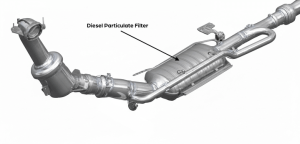
Combustion inside a Mercedes diesel engine produces fine particles. Left unchecked, those particles would pass straight into the atmosphere. The diesel particulate filter, fitted within the emissions system, catches them as exhaust gases flow through.
As the filter does its job, particulate matter (soot) collects inside it. That accumulation is a normal part of how the system works. Your Mercedes runs a built-in process called regeneration that raises the temperature inside the filter so the trapped soot is oxidised and reduced, at intervals shaped by how you drive.
The important thing to understand is this: when regeneration completes as it should, you may have no reason to notice the system at all. When it can’t run, soot keeps collecting, the filter grows more restricted, and a warning appears on the dashboard.
Mercedes DPF Regeneration: The Sustained Driving Your Engine Needs
Mercedes DPF regeneration is your vehicle’s method of reducing the soot in the diesel particulate filter. Without it, the filter would reach capacity and stop working as intended.
The process requires the engine to reach and hold specific running conditions over a continuous period, in practice, a steady drive at a consistent speed once it’s warmed through. Exactly what’s needed varies between Mercedes models and how the car is being driven.
In those conditions, exhaust temperatures climb high enough for the soot to be oxidised and reduced. Often, the engine management system raises the exhaust temperature itself to get the process going. It runs automatically in the background while you drive.
That’s where the pattern becomes important. Regeneration isn’t a one-off. The system needs to complete the cycle regularly, how often depending on how you use the car. Given the chance, the filter carries on working. The difficulty starts when it doesn’t.
What Stops a Mercedes DPF Regenerating
One of the most common reasons for the warning to appear is that the vehicle hasn’t had the driving conditions that regeneration requires.
Short journeys around town, stop-start commuting, and runs where the engine can’t reach and hold the right operating conditions are the typical pattern. Soot builds up and the system can’t keep pace; restriction grows, and the warning is triggered.
The reality is, driving patterns aren’t the full picture. Trouble in the engine, somewhere in the emissions system, or with a related sensor can stop regeneration completing too, even when the driving should have allowed it. A proper investigation tells the two apart: whether it’s down to how the car is used, or a fault that needs putting right whatever the driving.
If that warning has shown up, the sooner you have it looked at, the more room there is to sort it. Call Standish Service Station on 01257 422899 and we’ll explain what’s likely to come next.
How to Read a Mercedes DPF Warning
How your Mercedes flags a DPF fault varies by model, whether that’s the engine management light, a filter symbol on the instrument cluster, or a message on the display. What none of them does is tell you, on its own, exactly what’s wrong.
In some instances it’s simply that regeneration hasn’t been completing. In others, a different fault is holding the system back. Since the fix depends on which, the answer is to have the cause established rather than assumed.
Go by what the dashboard is telling you, and have the car assessed if the warning persists or returns. The earlier that happens, the better the chance of catching the cause while the repair is still contained.
If a warning is showing and you suspect the DPF, contact Standish Service Station on 01257 422899. We’ll get to what’s behind it and set out the next step.
What Leaving a Mercedes DPF Warning Can Lead To
It’s worth knowing a warning like this can go out by itself; a completed regeneration cycle on a longer run will sometimes do it. What you can’t assume is that it will. If the cause is something the driving won’t fix, the restriction stays, and putting it right gets no easier with time.
If it does build, you may start to notice changes: reduced pull, changes in fuel consumption, or the engine running rough. These point to exhaust gases struggling to flow through the filter as freely as they should.
Past a certain level of restriction, the engine management system may drop the car into limp mode. It’s a safeguard: power is deliberately capped so no further harm is done. A Mercedes DPF blocked that badly tends to leave the car feeling flat, and keeping up with normal traffic may no longer be realistic.
Then there’s the MOT. On any diesel first used on or after 1 July 2008, an engine management light that’s on at the test means an automatic fail. A filter restricted or damaged enough to send emissions over the allowed figures is a second way to fail. The sensible move is to get it seen ahead of the test.
If it’s been showing for a while, get it assessed before things move further in the wrong direction. Speak to the team at Standish Service Station on 01257 422899 and we’ll give you a straight read on it.
How Standish Service Station Approaches a Mercedes DPF Fault
Before any equipment is connected, our technicians want the full picture. What prompted you to come in, how the car has been running, and what your day-to-day driving involves. That conversation sets the direction for everything that follows.
Once that’s clear, they run a full technical evaluation on manufacturer-level software. It provides far more than a fault code can, offering a clear view of what the emissions system has been doing and why regeneration hasn’t been going through.
This is the gap between reading a code and understanding a cause. A code can say something’s wrong; the data behind it, reached through manufacturer-level software, shows why, how far it’s gone, and what the right course of action is.
The objective is to identify the root cause, deal with it, and make sure the same fault doesn’t return. Before any work starts, we’ll set out what we’ve found and what it calls for, and answer whatever you want to ask. Each vehicle presents a different picture, and the approach is shaped by what the data shows.
What Sets a Full Mercedes DPF Investigation Apart from a Basic Code Read
Reading a fault code is where most generic checks stop. A code might confirm a DPF-related issue exists, but not why regeneration isn’t running, what’s blocking it, or how far along the restriction is.
Answering those takes manufacturer-level software that reads the detailed, Mercedes-specific data the car stores: DPF-related values, sensor readings, and operating data a generic scan tool can’t get near. Without that depth, you’re working half-blind.
Even then, the data alone won’t hand you the answer. Reading what those figures mean, and knowing which leads to chase first, takes real experience with Mercedes diesel systems. One soot-related code can trace back to several different root causes, and settling on the right one takes a technician who can work through them methodically.
Our technicians at Standish Service Station, Wigan, handle Mercedes diesels as part of their regular workload. From a Mercedes C-Class DPF fault to warnings on E-Class or GLC models, they bring the hands-on experience and manufacturer-level software to reach the right diagnosis. If there’s a warning or message on your dashboard, ring us on 01257 422899.
Mercedes DPF Issue: Why Standish Service Station, Wigan
The outcome of a DPF problem depends on how thoroughly it’s investigated and on finding the root of the issue. A garage with the right experience and equipment can make the difference between recovering the filter and replacing it.
At Standish Service Station, Wigan, Mercedes diesel models are part of our regular workload. Our technicians bring the hands-on experience and the manufacturer-level software needed to get to the root of a DPF issue and carry out the repair to the correct standard.
When you bring your Mercedes to us, you can expect:
- Technicians experienced with Mercedes diesel emissions systems
- A technical evaluation using manufacturer-level software, not a generic code reader
- A free courtesy car while your vehicle is with us
- A 12-month parts and labour guarantee on all work carried out
{{average-rating}} on Google from {{review-count}} Wigan customers, who point to the quality of our work and the clarity of our communication.
Seeing something on your dashboard you’d like checked? Ring us on 01257 422899 and we’ll explain what’s involved and get your Mercedes booked in.
Mercedes DPF: Frequently Asked Questions
Can a DPF fault fail my Mercedes at its MOT?
It can. An engine management light lit at MOT time is enough on its own to fail any diesel first used on or after 1 July 2008. And a Mercedes DPF blocked far enough to send emissions over the limit will fail as well. If you’ve been driving with the warning a while, get it checked before your test date. Ring Standish Service Station on 01257 422899.
Is it OK to keep driving when a Mercedes DPF warning shows?
Whether it’s safe depends on what the car is asking of you. Lots of different issues can bring a warning up, so by itself it’s no proof the DPF is the culprit. Do what the dashboard advises, and have the car looked at if the warning won’t clear or keeps returning. And if it tells you to pull over or get assistance, act on that and call Standish Service Station on 01257 422899.
What is Mercedes DPF regeneration, exactly?
It’s the car’s built-in way of dealing with the soot inside the diesel particulate filter: the exhaust runs hot enough for that soot to oxidise and break down. The engine has to hold particular conditions for a sustained period; when everyday driving doesn’t provide them, soot accumulates, the filter restricts, and a warning appears.
Do DPF problems affect all Mercedes diesels?
Any Mercedes diesel fitted with a particulate filter can run into regeneration faults. A Mercedes C-Class DPF fault is among the more frequently reported, and the E-Class and GLC come up too, though they aren’t the only ones. The filter itself does one job everywhere it’s fitted; it’s the system built around it, and the faults that turn up, that shift from model to model. Standish Service Station can assess any Mercedes diesel. Call us on 01257 422899.