Volkswagen Golf Transmission Fault
The gear change felt wrong. Then it happened again. Then a warning appeared on the dashboard.
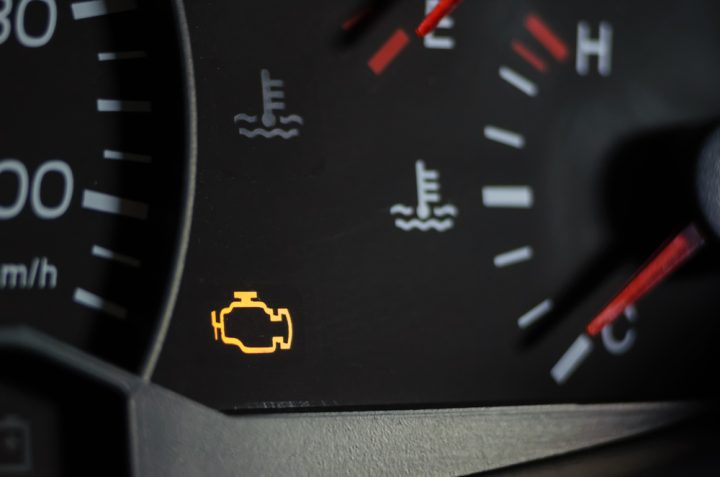
For Mrs H, the signs that something had gone wrong with her 2020 Volkswagen Golf were hard to miss. The gearbox had started shifting erratically, certain gears were failing to engage during normal driving, and a transmission fault warning was now showing on the dashboard.
There had been nothing to suggest a problem was developing. No unusual sounds, no change in driving habits, and no work recently carried out on the car. Mrs H was left uncertain about what had caused it, whether the vehicle was still safe to drive, and what needed to happen next.
Mrs H, from Wigan, contacted Standish Service Station, Standish, looking for a team she could rely on to find and fix the problem. The symptoms left no room for doubt that this was a Volkswagen Golf transmission fault that needed a thorough investigation and an effective repair.
She needed specialists with the diagnostic experience, technical resources, and manufacturer-level equipment to get to the cause and resolve it properly.
Mrs H booked the Golf in with Standish Service Station for a full technical evaluation.
Mrs E’s Volkswagen Golf arrived with a transmission warning, rough gear changes and certain gears no longer engaging correctly
Reviewing Mrs H’s Concerns and Carrying Out Initial Checks
At Standish Service Station, Standish, our technicians began by speaking with Mrs H in detail about what she had noticed. We asked when the erratic gear changes had first started, how the fault was presenting on a day-to-day basis, and whether conditions such as vehicle speed, outside temperature, or journey length appeared to have any effect.
This kind of input adds context that no scan tool can replicate. It gives our technicians a grounded understanding of the fault before any testing begins and helps ensure the evaluation is pointed in the right direction from the start.
A road test followed to confirm the described symptoms under driving conditions. Manufacturer-level diagnostic equipment was connected throughout, capturing serial data from the transmission control module while the Golf was being driven. This allowed our technicians to observe the transmission’s behaviour first-hand at the exact moments the fault presented.
A full system scan was completed during the road test, returning a stored fault code directly relevant to the Volkswagen Golf transmission fault:
- P1736 00 — Position sensor for clutch 2, electrical malfunction. Active.
This indicated that the transmission control module had detected an electrical fault involving one of the internal sensors used for clutch monitoring. But an accurate transmission warning light diagnosis requires more than identifying a code. It requires understanding what the code reveals about the component that has failed.
To establish what the Volkswagen P1736 fault code was pointing to, and to confirm the appropriate next steps, our technicians moved into a deeper phase of investigation.
How Our Technicians Traced the Volkswagen Golf Transmission Fault to Its Source
Fault code P1736 had identified an electrical malfunction with the position sensor for clutch 2. That gave a direction, but not a conclusion. Before committing to a repair for this Volkswagen Golf transmission fault, our technicians needed to pinpoint exactly what had failed and what had caused it. A disciplined diagnostic process was followed, testing each relevant area in sequence to arrive at a conclusion backed by hard evidence.
Step 1: Consulting manufacturer technical data
Our technicians consulted Volkswagen’s technical information service to understand the design and function of the transmission in Mrs H’s Golf.
The 2020 Golf was fitted with a seven-speed Direct Shift Gearbox (DSG), a dual-clutch transmission widely used across the Golf range. Two independent clutches work within the system: clutch 1 takes care of odd gears (1, 3, 5, 7) and clutch 2 takes care of even gears (2, 4, 6, and reverse). Gear selection and clutch engagement are controlled by a mechatronic unit, a single integrated assembly that combines the transmission control unit (TCU) with a hydraulic valve body.
A crucial detail is that clutch position in this transmission is not measured by an external sensor fitted separately. The mechatronic unit houses its own integrated pressure sensors, and these provide the data the system depends on for clutch control. Clutch position is then calculated from those pressure values. When fault code P1736 references “position sensor for clutch 2,” it is identifying this integrated pressure sensor inside the mechatronic unit.
This was an important finding. It told our technicians that the fault almost certainly sat within the mechatronic unit itself, not at any component mounted externally.
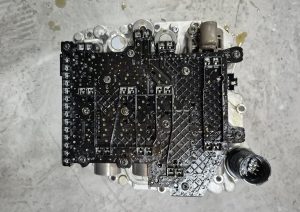
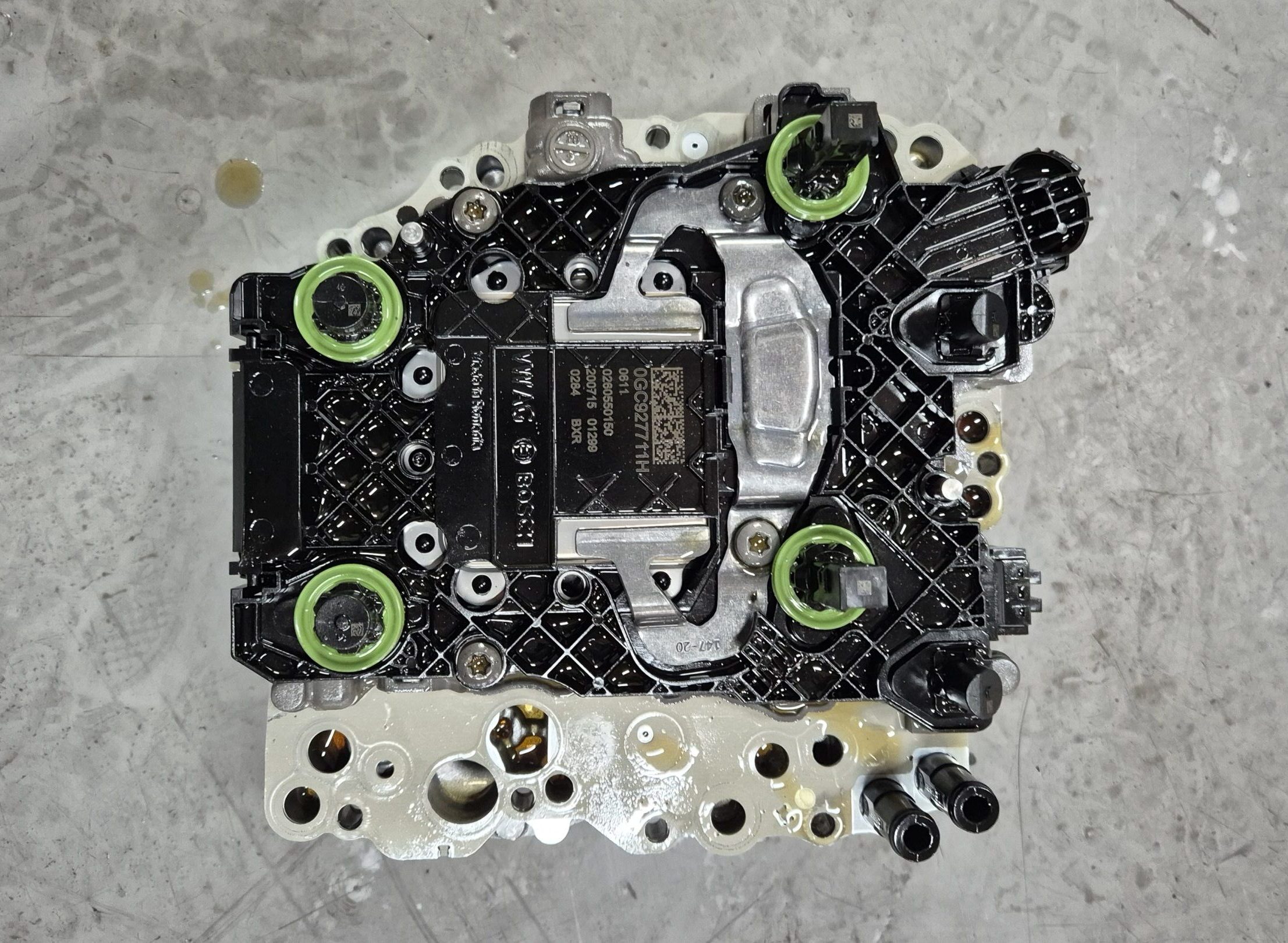
Inspection of the DSG mechatronic unit. Diagnostic testing traced the P1736 fault to the integrated clutch 2 pressure sensor within the unit
Step 2: Checking for technical service bulletins
Our technicians checked for technical service bulletins (TSBs) relating to the diagnostic trouble code (DTC) and the symptoms Mrs H had described.
- A bulletin was found that covered the specific fault code and the behaviour being reported
- It recognised this as a known issue with DQ381 transmissions, attributed to wear of the integrated pressure sensors within the mechatronic unit
- The bulletin set out that as these sensors deteriorate or drift beyond their calibrated range, the TCU receives inaccurate pressure data and miscalculates clutch position, resulting in failed gear engagement and erratic behaviour from the transmission
This aligned with what the Volkswagen P1736 fault code had indicated, but direct testing was still required to confirm the fault before the repair could go ahead.
Step 3: Serial data analysis at rest
With the vehicle stationary, the engine off, and the ignition on, our technicians checked the pressure values for both clutches using manufacturer-level diagnostic equipment.
- Both clutch pressure readings should sit as close to 0.00 bar as possible under these conditions in a transmission that is functioning correctly
- The clutch 2 reading was clearly outside the expected range, pointing to a sensor that had drifted beyond its intended calibration
- The clutch 1 reading was within normal parameters, confirming the issue was isolated to the clutch 2 side
The pressure data was fully consistent with the Volkswagen P1736 fault code and with what Mrs H had been experiencing on the road. The even-numbered gears were the ones being affected, exactly as a clutch 2 sensor fault would produce.
Step 4: Visual inspection
Our technicians carried out a visual inspection of the mechatronic unit’s exterior, wiring harness, and all connectors, looking for physical damage, corrosion, or connection faults.
- No external issues were found, ruling out any cause outside the mechatronic unit
The conclusion
The diagnostic process had left no room for uncertainty. The Volkswagen P1736 fault code pointed directly to the integrated pressure sensor for clutch 2, mounted on the TCU circuit board inside the mechatronic unit. This sensor had drifted outside its specification and was no longer feeding accurate hydraulic pressure data for the clutch 2 sub-transmission. The consequence was that the TCU was miscalculating clutch position, leading to incorrect engagement of the even-numbered gears.
As this sensor is integrated into the mechatronic assembly, it is not available as a separate serviceable part. The mechatronic unit needed to be replaced.
Replacing the Mechatronic Unit and Restoring Correct Gearbox Operation
Our technicians walked Mrs H through every finding and explained the repair in detail. She gave her approval, and the work commenced without delay.
Mechatronic unit replacement
- Transmission oil was drained and the mechatronic unit was accessed by removing the transmission oil pan and associated components
- The faulty mechatronic unit was carefully disconnected and lifted out of the transmission
- The replacement unit was fitted into position, with all electrical connections, mounting points, and seals checked to confirm precise fitment
- Fresh transmission oil was filled to the correct Volkswagen specification, following manufacturer procedure
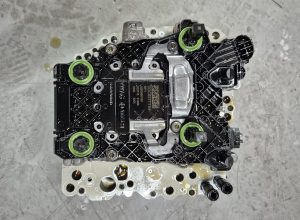
The faulty mechatronic unit was removed and replaced before the transmission was calibrated and adapted using manufacturer-level diagnostic software
Calibration and adaptation
- A calibration and adaptation procedure was carried out using manufacturer-level diagnostic software. After mechatronic replacement, this step is essential as it allows the new TCU to match its operation to the current condition of the transmission and clutch components
- All stored fault codes were cleared from the system
Post-repair road test
- The Golf was taken on a structured road test, giving the transmission the real driving conditions it needed to complete clutch adaptation
- Our technicians monitored throughout, confirming that every gear selected smoothly, no gears were being missed, and no new fault codes had been recorded
The Outcome for Mrs H and Her Volkswagen Golf
The Volkswagen gearbox mechatronic repair addressed the Volkswagen Golf transmission fault at its source. The gearbox was selecting every gear cleanly, shifting without hesitation, and operating with no dashboard warnings present.
What stood out about this repair was the speed and accuracy of the outcome. From the moment Mrs H’s Golf arrived at Standish Service Station, our technicians followed a structured, evidence-led technical evaluation that identified the root cause and led to the correct repair being carried out within a single visit. The automatic transmission fault repair met manufacturer standards throughout, drawing on the same technical data and equipment used at a main dealership. Mrs H received all of this at a more competitive price than a main dealer, and a complimentary courtesy car kept her mobile while the work was completed.
Mrs H collected her Golf from Standish Service Station with the transmission performing as it should and complete confidence in the work that had been done.
Experiencing Volkswagen Transmission Problems? Contact Standish Service Station
If your Volkswagen is shifting erratically, failing to engage gears, or displaying a transmission warning on the dashboard, getting it assessed by specialists early is the best course of action. The longer a transmission fault is left, the greater the strain on internal components and the higher the risk of additional damage.
By choosing Standish Service Station in Standish, you benefit from:
- Specialists with proven experience in complex Volkswagen transmission faults
- Access to manufacturer-level technical data, service bulletins, and dealer-level equipment
- A structured, evidence-led technical evaluation throughout the process
- Manufacturer-standard repairs at a more competitive price than a main dealer
- A complimentary courtesy car while the work is completed
- A 12-month parts and labour guarantee for peace of mind
Trusted by drivers across Wigan and Bolton, Standish Service Station has a {{average-rating}} star Google rating from {{review-count}} reviews. Call 01257 422899 to book your Volkswagen in with our team.